What Is AI Governance? 7 Questions Every Board Should Ask
Artificial intelligence is rapidly becoming part of everyday business operations. Organizations use AI to support decisions, automate processes, analyze information and improve customer experiences.
Yet adopting AI is not simply a technology decision. It creates questions about accountability, risk, oversight and long-term business value.
This is where AI governance becomes essential.
What Is AI Governance?
AI governance is the framework of responsibilities, policies, controls and decision-making processes used to guide how an organization selects, develops, deploys and monitors artificial intelligence.
Good governance does not exist to slow innovation. Its purpose is to ensure that AI initiatives remain aligned with business objectives, organizational values and acceptable levels of risk.
For boards and executive teams, AI governance means being able to answer three fundamental questions:
- Why are we using AI?
- Who is accountable for its outcomes?
- How do we know that it continues to operate as intended?
Technology teams cannot answer these questions alone. They require executive direction and continuous oversight.
Why Boards Need to Address AI Governance
AI can influence strategic decisions, employees, customers, suppliers and corporate reputation. Even when an external vendor provides the technology, the organization remains responsible for how it is selected and used.
Without clear governance, AI initiatives can create fragmented experimentation, unclear ownership and risks that only become visible after implementation.
Boards do not need to become AI engineers. They do, however, need a structured way to challenge assumptions, understand exposure and ensure that management remains accountable.
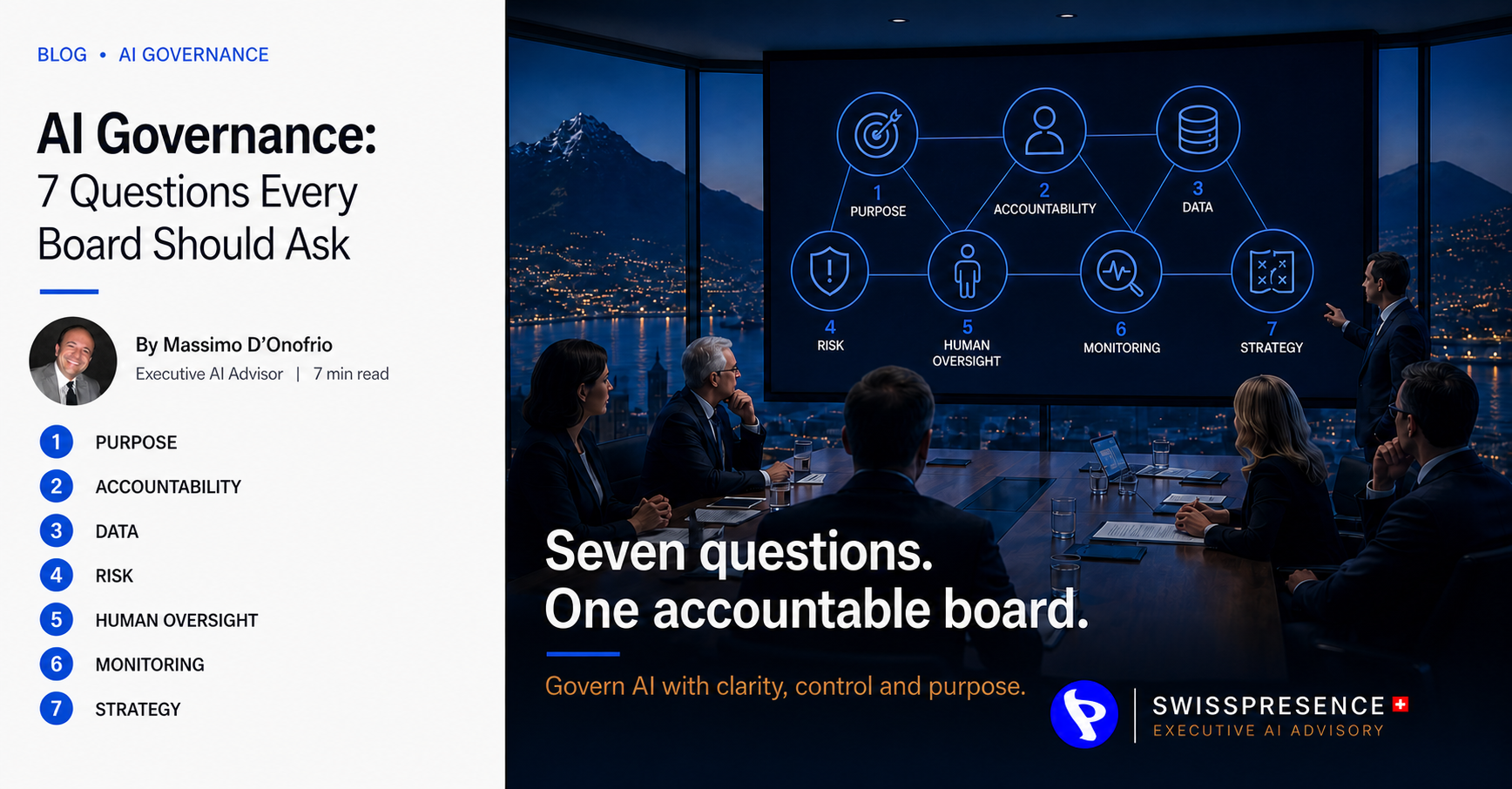
The following seven questions provide a practical starting point.
1. What Business Objective Does This AI Initiative Support?
Every AI initiative should begin with a defined business need.
The board should understand whether the initiative is intended to reduce costs, improve decisions, increase revenue, manage risk or create a better customer experience.
“Using AI” is not a strategy. A credible initiative must connect technology with a measurable business outcome.
Boards should ask management to explain:
- the problem being addressed;
- why AI is an appropriate solution;
- the expected benefits;
- how success will be measured.
If the business objective is unclear, the organization may be investing in experimentation without a realistic path to value.
2. Who Is Accountable for the Outcome?
AI governance requires named accountability.
Responsibility can easily become fragmented between management, technology teams, external consultants and software providers. When everyone is partially responsible, no one is truly accountable.
Each material AI initiative should have an executive owner with the authority to make decisions and the obligation to report on performance and risk.
Technical teams may operate the system, but executive leadership must own its business consequences.
3. What Data Does the System Use?
The quality and legitimacy of data directly affect the quality of AI outcomes.
Boards should understand the categories of data involved, where that data comes from and whether its use is consistent with organizational policies and stakeholder expectations.
Important questions include:
- Is the data accurate and sufficiently representative?
- Does the organization have the right to use it?
- Is confidential or personal information involved?
- How is data protected and retained?
- Can errors or bias influence the result?
The board does not need to inspect individual datasets, but it should ensure that appropriate controls and responsibilities exist.
4. What Could Go Wrong?
Risk assessment should take place before implementation, not after a problem appears.
Potential risks can include inaccurate outputs, discrimination, privacy breaches, intellectual-property exposure, cybersecurity vulnerabilities, regulatory non-compliance and reputational damage.
The significance of each risk depends on the context. An internal productivity assistant does not require the same level of oversight as a system influencing credit, employment, healthcare or other consequential decisions.
Governance should therefore be proportionate to the potential impact.
5. Where Is Human Judgment Required?
AI can support decisions, but organizations must define when human review is necessary.
Boards should ask whether employees can challenge or override an AI-generated result and whether responsibilities are clear when humans and automated systems interact.
Human oversight should be meaningful. It is not enough to place a person at the end of a process if that person lacks the information, competence or authority needed to question the system.
6. How Will Performance Be Monitored?
AI governance continues after deployment.
Data, business conditions and technologies change. A system that performs well today may become less reliable or less appropriate over time.
Management should define:
- performance indicators;
- risk indicators;
- review frequency;
- escalation procedures;
- conditions for suspending or retiring the system.
Continuous oversight allows the organization to identify declining performance and unexpected consequences before they become material problems.
7. How Does This Initiative Fit the Wider AI Strategy?
Individual AI projects should not operate in isolation.
The board should understand how each initiative contributes to the organization’s broader strategy, governance framework and technology architecture.
A fragmented portfolio can create duplicate costs, incompatible systems and inconsistent controls. A coordinated approach helps management prioritize investments and build reusable capabilities.
The objective is not to approve every technical decision. It is to ensure that AI adoption develops in a deliberate, governed and sustainable way.
From Governance to Business Value
Effective AI governance creates the conditions for responsible innovation.
When objectives, responsibilities and controls are clear, organizations can make decisions faster and invest with greater confidence. Governance reduces uncertainty and helps leadership distinguish valuable initiatives from technology-driven experimentation.
The strongest approach connects:
- business strategy;
- executive accountability;
- risk management;
- implementation;
- continuous oversight.
This is the foundation of Trusted AI.
The Swisspresence Perspective
Swisspresence helps boards, owners and executive teams transform AI ambition into governed and measurable business capability.
Our approach begins with business decisions rather than technology. Through executive AI advisory, AI governance and the SP AICO™ methodology, we help organizations establish priorities, clarify accountability and maintain oversight throughout the AI lifecycle.
Ready to Govern AI with Confidence?
Effective AI governance begins with clear accountability, proportionate controls and continuous executive oversight.
Swisspresence helps boards and leadership teams transform AI ambition into trusted, governed and measurable business capability.