AI Governance Framework: A Practical Implementation Roadmap
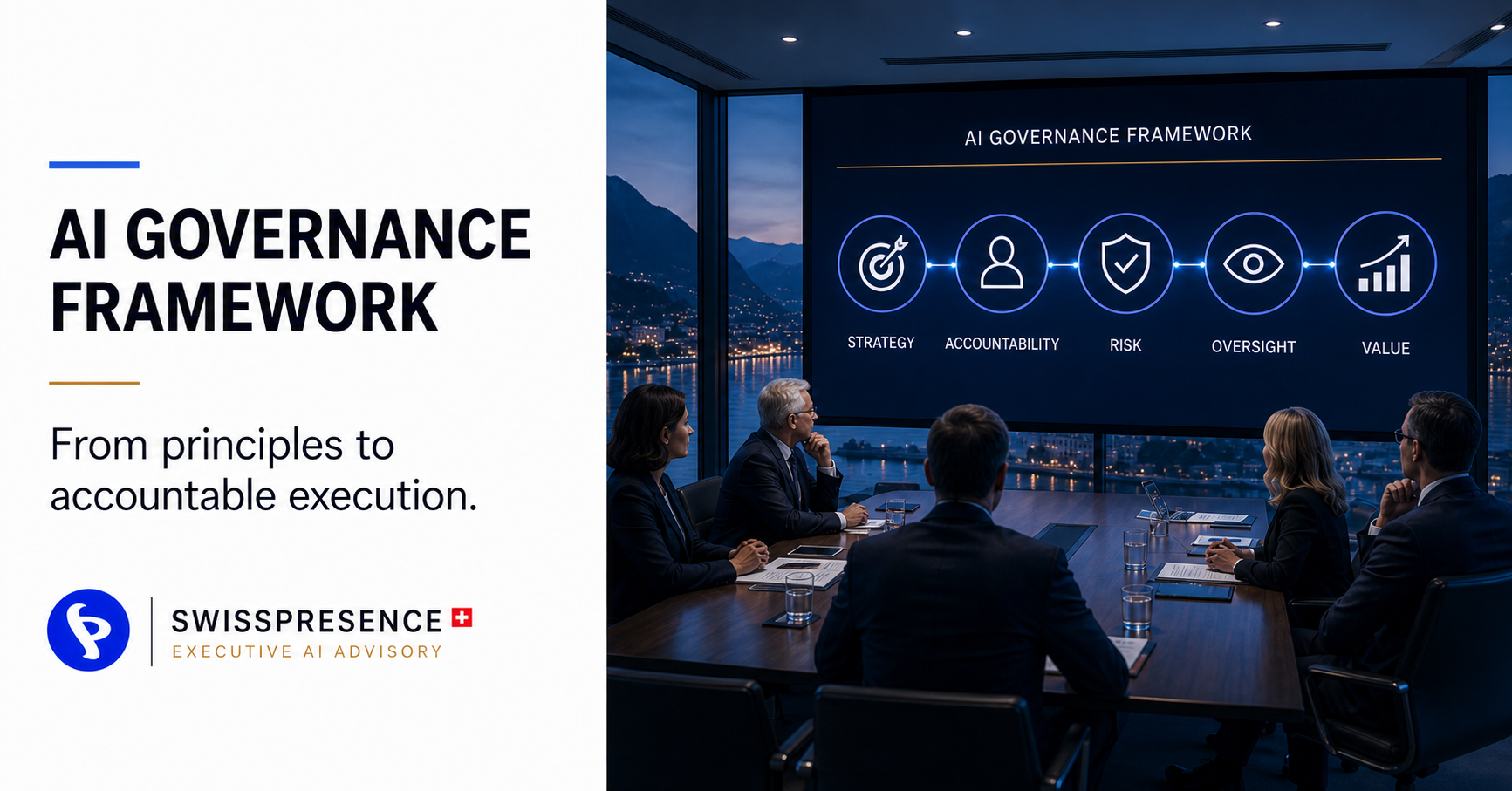
Artificial intelligence is moving rapidly from isolated experimentation into everyday business operations. As adoption expands, organizations need more than principles and policies. They need a practical AI governance framework that connects strategy, accountability, risk management, oversight and measurable value.
An effective framework does not exist to slow innovation. It gives boards and executive teams the clarity required to make better decisions, assign responsibility and scale AI with confidence.
What Is an AI Governance Framework?
An AI governance framework is the system of responsibilities, decision rights, policies, controls and monitoring processes used to guide how an organization selects, develops, deploys and oversees artificial intelligence.
It translates high-level commitments into repeatable business practice. It should help leadership answer fundamental questions:
- Why are we using AI?
- Who owns the business outcome?
- What risks and obligations must be managed?
- Where is human judgment required?
- How will performance remain visible over time?
- When should an AI system be changed, suspended or retired?
For a broader introduction, read What Is AI Governance? A Practical Guide for Boards.
Why Organizations Need a Practical Framework
AI initiatives often begin in different departments, with different providers and different expectations. Without a common governance structure, organizations can accumulate fragmented pilots, duplicated costs, inconsistent controls and unclear accountability.
The central challenge is not simply technical. AI can affect customer relationships, employees, confidential information, regulatory obligations, investment priorities and corporate reputation. These consequences require coordinated business decisions.
A practical framework creates consistency without treating every use case in the same way. A low-impact productivity tool should not require the same degree of oversight as a system influencing employment, credit, healthcare or another consequential decision. Governance should be proportionate to purpose, exposure and potential impact.
The Five Elements of an Effective AI Governance Framework
1. Strategy: Connect AI to Business Objectives
Governance begins with strategic intent. Every material AI initiative should support a defined business objective, such as improving decision quality, increasing operational efficiency, creating revenue, strengthening risk management or delivering a better customer experience.
Leadership should be able to distinguish genuine business opportunities from technology-driven experimentation. Before committing resources, management should define the problem, explain why AI is appropriate and establish how success will be measured.
This strategic discipline also helps organizations prioritize a coherent portfolio instead of accumulating disconnected projects. Learn more about aligning investment and execution in our AI Strategy advisory.
2. Accountability: Establish Ownership and Decision Rights
AI governance cannot operate through collective ambiguity. Each significant initiative needs a named executive owner who is accountable for its business outcome and empowered to make decisions.
Responsibilities should be clear across the board, executive leadership, business functions, technology teams, risk specialists and external providers. Technical teams may build or operate a system, but management remains accountable for how it is used and for its consequences.
Decision rights should cover approval, deployment, material changes, exceptions, escalation, suspension and retirement. This prevents responsibility from becoming fragmented when circumstances change or problems emerge.
3. Risk: Apply Proportionate Controls
AI risks depend on context. Relevant considerations can include unreliable outputs, bias, privacy, cybersecurity, intellectual property, regulatory compliance, operational dependency and reputational harm.
The framework should classify AI initiatives according to their purpose and potential impact. Higher-impact systems require stronger documentation, testing, human oversight and executive review. Lower-impact uses can follow a simpler path while remaining visible within the organization.
Risk assessment should begin before implementation and continue throughout the lifecycle. Our AI Risk Management approach helps organizations translate exposure into proportionate governance measures.
4. Oversight: Monitor Performance and Emerging Issues
Approval is not the end of governance. Data changes, models evolve, providers update their systems and business conditions shift. An AI application that performs appropriately today may become unreliable or unsuitable over time.
Management should therefore establish performance indicators, risk indicators, review frequency, reporting responsibilities and escalation thresholds. Monitoring should address both technical behaviour and business consequences.
Human oversight must also be meaningful. A person cannot provide effective review without sufficient information, competence, time and authority to challenge or override an AI-generated result.
5. Value: Measure Sustainable Business Outcomes
Governance should protect value, not merely control risk. Organizations need a disciplined way to determine whether AI initiatives deliver the expected benefits after implementation.
Measurement may include financial returns, productivity, decision quality, customer outcomes, resilience or risk reduction. The appropriate indicators depend on the original business objective, but they should be established before deployment.
When performance and value remain visible, leadership can expand successful initiatives, correct underperforming ones and stop investments that no longer justify their cost or exposure.
A Practical Implementation Roadmap
The framework should be introduced in manageable stages. Attempting to design every policy and control at once can create complexity without improving accountability.
Step 1: Establish the Governance Mandate
Define why AI governance matters to the organization, which decisions require executive or board visibility and who will sponsor the framework. Agree on a small set of principles that reflect business strategy, organizational values and risk appetite.
Step 2: Create an AI Inventory
Identify AI systems already in use, including embedded features within existing software and tools adopted informally by employees. Record their purpose, owner, provider, data, users and potential impact. An organization cannot govern systems it cannot see.
Step 3: Classify Use Cases by Impact
Introduce a proportionate classification method. Consider who may be affected, the significance of the decision, the sensitivity of the data, the level of automation and the consequences of error. Use this classification to determine the required approval and controls.
Step 4: Define the AI Lifecycle
Establish clear stages from idea and assessment through approval, development, deployment, monitoring and retirement. Define the evidence and decisions required at each stage, while avoiding unnecessary bureaucracy for low-impact uses.
Step 5: Assign Roles and Escalation Paths
Clarify who proposes, approves, implements, monitors and challenges each initiative. Establish escalation paths for incidents, unexpected behaviour, performance deterioration and changes in risk.
Step 6: Integrate Governance into Existing Processes
AI governance should connect with strategy, procurement, information security, privacy, legal review, enterprise risk and internal audit. Building a completely separate structure can create duplicated work and conflicting responsibilities.
Step 7: Report to Leadership
Boards and executives need concise information about the AI portfolio, material risks, performance, incidents and value creation. Reporting should support decisions rather than overwhelm leadership with technical detail.
Questions Boards Should Ask
Boards do not need to approve every technical choice. They should, however, expect management to provide credible answers to a focused set of governance questions:
- What business objective does the initiative support?
- Who is accountable for its outcome?
- What data does the system use?
- What could go wrong?
- Where is human judgment required?
- How will performance be monitored?
- How does the initiative fit the wider AI strategy?
Explore these questions in detail in AI Governance: 7 Questions Every Board Should Ask.
Common Implementation Mistakes
- Treating governance as a policy exercise: principles without owners, decisions and monitoring rarely change behaviour.
- Delegating governance entirely to technology teams: AI consequences extend beyond technical performance.
- Applying identical controls to every use case: disproportionate governance creates unnecessary friction and weakens focus on material risks.
- Ignoring third-party AI: using an external provider does not transfer organizational accountability.
- Stopping at deployment: performance, data and external conditions continue to change.
- Measuring activity instead of value: the number of pilots does not demonstrate sustainable business impact.
From Principles to Accountable Execution
A strong AI governance framework connects strategic direction with everyday decisions. It clarifies accountability, applies proportionate controls, maintains continuous oversight and keeps attention on measurable business value.
Organizations do not need to wait for a perfect framework. They need a credible starting point, clear ownership and a process that improves as experience grows.
Through AI Governance advisory and the SP AICO™ methodology, Swisspresence helps boards and executive teams transform AI principles into governed, practical and sustainable business capability.
Build an AI Governance Framework That Works in Practice
Swisspresence supports boards and executive teams in establishing strategic priorities, decision rights, proportionate controls and continuous oversight.