From Stakeholder Voice to Accountable AI Decisions
AI governance is often described through policies, controls, risk registers and technical safeguards. These elements matter—but they do not answer a fundamental question: how does an organization turn the perspectives of people affected by AI into accountable executive decisions?
Stakeholder engagement in AI governance is increasingly recognized as essential to responsible adoption. Employees, customers, business partners, investors, regulators and communities can reveal consequences that may remain invisible during technical design and testing. Yet consultation alone does not create accountability. Unless stakeholder perspectives influence decision rights, ownership, controls and documented action, engagement risks becoming procedural rather than operational.
For boards and executive teams, the challenge is therefore not simply to ask who should be consulted. It is to establish how stakeholder input changes decisions—and who remains accountable when interests conflict.
Stakeholder Engagement Is Governance, Not Public Relations
Organizations often involve stakeholders too late. Feedback may be requested after a system has been selected, configured or deployed, when the most consequential choices have already been made. In other cases, consultation produces extensive documentation without a clear mechanism for deciding which concerns require action.
Meaningful engagement should begin when an AI initiative is framed and continue throughout its lifecycle. It should help leadership identify affected groups, understand competing interests, anticipate unintended consequences and determine what evidence is required before deployment or expansion.
This complements the broader principles described in our AI Governance advisory: governance must connect strategic direction with accountability, proportionate risk controls and continuous oversight.
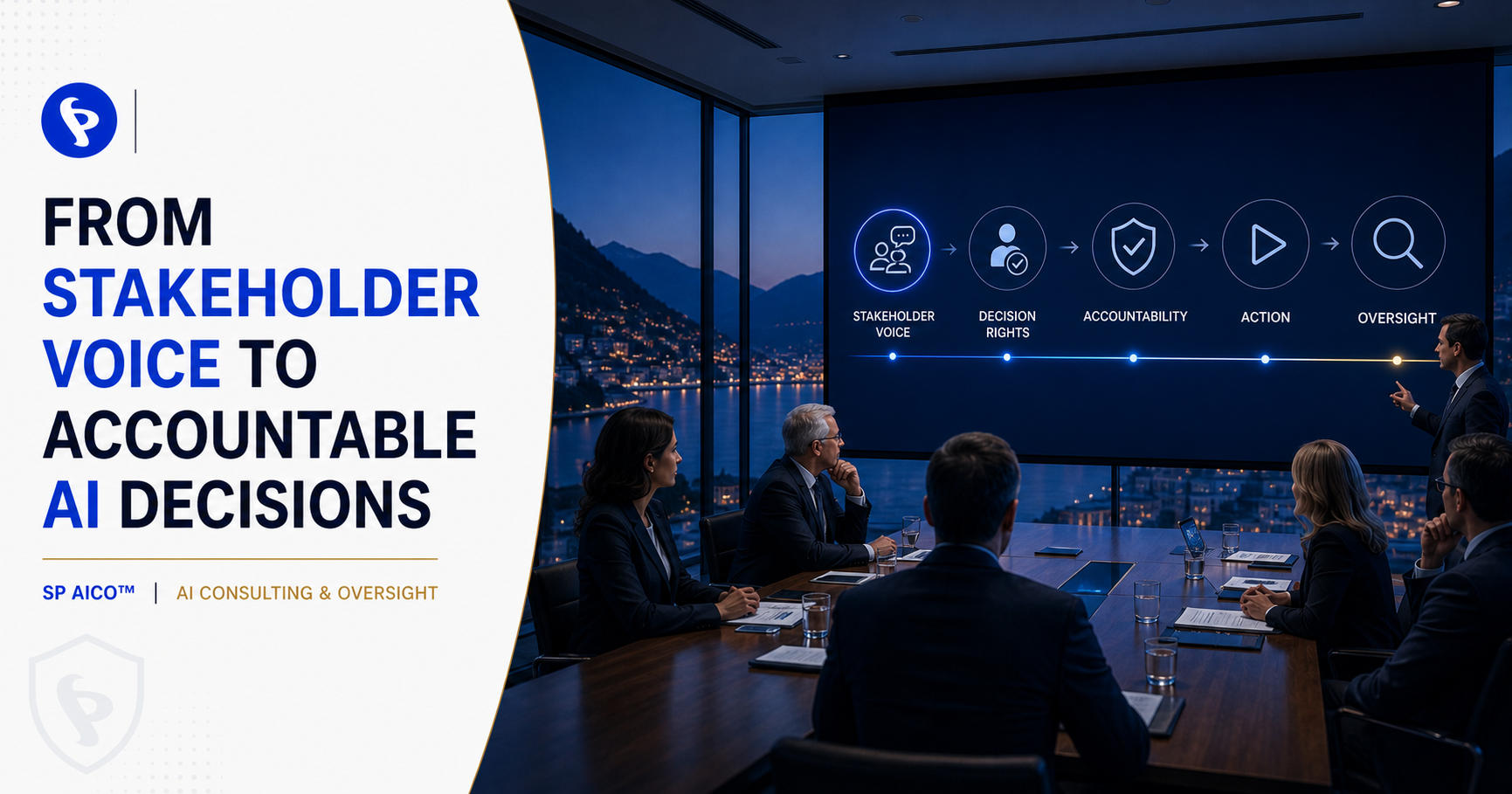
From Voice to Accountable Decisions: Five Connected Steps
1. Identify who is affected
Stakeholders are not limited to the direct users of an AI system. They may include people whose work, access, opportunities, privacy or reputation can be influenced by an AI-enabled decision. The relevant groups will vary according to the purpose, context and potential impact of each use case.
A useful mapping exercise asks who benefits, who bears risk, who supplies data, who operates the process, who can challenge an outcome and who has authority to intervene.
2. Define how stakeholders have a voice
Different stakeholders require different forms of engagement. Interviews, workshops, employee representation, customer research, expert review and formal consultation can all be appropriate. The method should reflect the level of impact and the practical ability of the group to participate.
Organizations should also make clear what the engagement can influence. Asking for feedback without defining its role creates unrealistic expectations and weakens trust.
3. Translate input into decision rights
Stakeholders provide knowledge, experience and legitimate concerns, but governance must still determine who decides. Leadership should define which matters can be resolved by the project team, which require independent review and which must be escalated to an executive owner, committee or board.
This is particularly important when interests conflict. Efficiency, customer experience, employee autonomy, regulatory obligations and commercial value may point in different directions. A mature framework does not pretend these tensions disappear; it establishes how they will be evaluated and who is accountable for the final decision.
4. Document decisions and actions
Governance requires evidence. Organizations should be able to show which stakeholders were considered, what concerns were raised, how those concerns were assessed, what decision was taken and which controls or changes followed.
Documentation should support accountability rather than create unnecessary bureaucracy. A concise, consistent decision record is often more valuable than a large collection of disconnected policies and meeting notes.
5. Maintain continuous oversight
Stakeholder impact can change after deployment. New users, new data, changing market conditions or an expanded purpose may alter the risk profile of an AI system. Engagement and monitoring should therefore continue through periodic reviews, incident reporting, performance analysis and defined escalation channels.
Oversight closes the loop between stakeholder experience and executive action. It also helps leadership decide when an AI system should be adjusted, restricted, suspended or retired.
What Boards and Executives Should Ask
- Which groups are materially affected by this AI initiative?
- At what stage are their perspectives considered?
- What decisions can stakeholder input influence?
- Who owns the business outcome and the associated risks?
- How are conflicting interests evaluated and escalated?
- What evidence demonstrates that feedback led to a decision or action?
- How will stakeholder impact be monitored after deployment?
These questions belong alongside the strategic and accountability questions discussed in What Is AI Governance? 7 Questions Every Board Should Ask.
How SP AICO™ Turns Principles into Accountable Execution
SP AICO™—AI Consulting & Oversight helps boards, business owners and executive teams translate responsible AI principles into practical governance. The methodology connects stakeholder perspectives with strategic objectives, decision rights, risk controls, measurable value and continuous oversight.
AI Governance Readiness Review
A focused starting assessment across strategy, accountability, risk, oversight and value. It includes a preliminary questionnaire, a 45-minute executive consultation, an executive scorecard and three priority recommendations.
Executive AI Advisory
Independent support for leadership teams that need to align AI initiatives, clarify ownership, challenge assumptions and make informed governance decisions.
AI Governance Framework
Design of governance roles, decision rights, proportional controls, escalation criteria and documented processes adapted to the organization and its AI portfolio.
Continuous AI Oversight
Periodic independent review of performance, controls, emerging risks, stakeholder impact and measurable business outcomes.
Start with an AI Governance Readiness Review
Before designing a larger governance program, establish where your organization stands today. The independent review identifies strengths, gaps and three practical priorities for leadership action.
Launch offer: CHF 490 excluding 8.1% Swiss VAT—CHF 529.69 total.
From Consultation to Accountable Action
Stakeholder engagement strengthens AI governance when it changes how decisions are made. The objective is not to give every stakeholder the same authority or to eliminate legitimate trade-offs. It is to ensure that affected perspectives are considered through a transparent process and that accountable leaders can explain what was decided, why it was decided and how outcomes will be monitored.
That is the point at which AI governance becomes operational rather than procedural—and where trust can be supported by evidence.