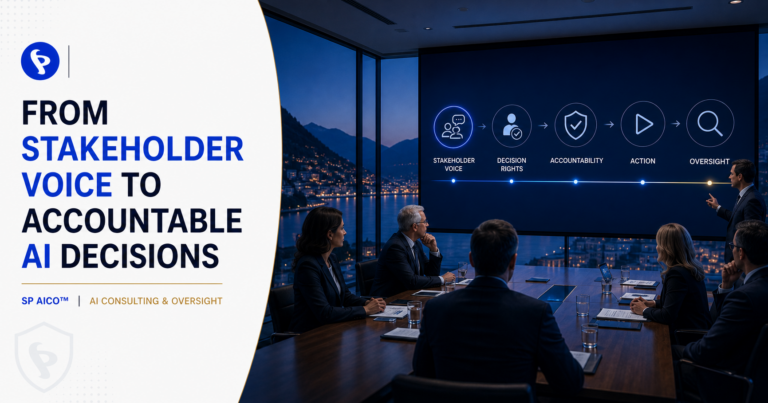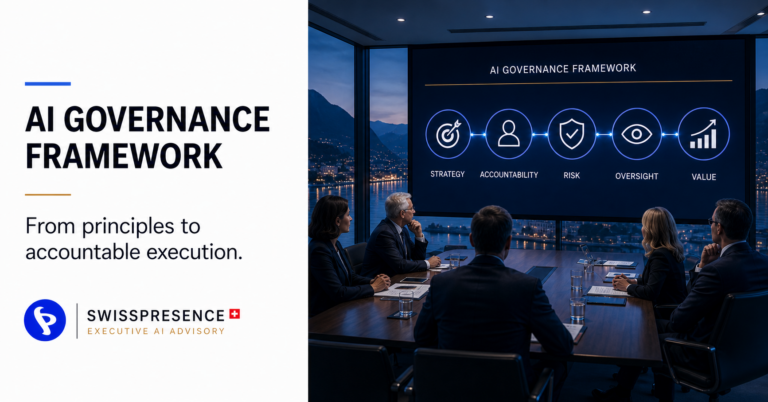

AI Agent Governance: Clear Authority for Business Workflows
An AI agent needs a clear mandate: which task it may perform, which information it may use, which actions it may take and when its authority ends. For a business owner, this is a practical management question before it becomes a technical configuration exercise.
A useful assistant can become an operational agent when it starts working across tools: reading a request, searching a knowledge base, preparing an answer and updating a record. The business must decide where independent execution is appropriate and where a person should intervene.
Why agent authority deserves attention now
In an August 27, 2026 article, NIST highlights identity and authorization as foundations for agentic AI. Its discussion warns against shared credentials, overly broad access and excessive approval requests that can lead to consent fatigue. This is guidance and ongoing work, not a new Swiss legal obligation or a certification of any product. Read the NIST article.
Our practical interpretation at Swisspresence is that an agent should receive a bounded business mandate. A mandate tells the team what successful execution looks like and what the system must leave to someone else. It also gives management a basis for reviewing whether the arrangement still makes sense.
A one-page mandate for a business agent
The following is a proposed SP AICO working template. It is a starting point for discussion with business, technology and security owners, rather than a technical standard.
- Purpose: describe one business outcome, such as preparing answers to routine product questions.
- Owner: name the person responsible for the process and its exceptions.
- Information: identify the approved sources and the information the workflow should not use.
- Actions: separate reading, drafting, updating and communicating. Permission to read a record does not by itself authorize sending its contents.
- Limits: set the permitted scope, operating period and resource budget for the task.
- Escalation: define the situations that require human judgement and who will respond.
- Evidence: decide what to record so that an action can be checked afterwards.
- Intervention: name who can pause the workflow and how the team confirms that it has stopped.
Put the approval where the decision matters
Consider a customer-service workflow. Searching an approved product catalogue and preparing a draft might sit within an agent’s standing mandate. Making a special commercial commitment or answering a complaint outside the approved process might require a named colleague to decide.
The reviewer needs the proposed action, the relevant evidence and a clear explanation of the exception. A button labelled “approve” is of limited use if the person cannot see what will happen. Teams should test whether reviewers have enough time and context to make a considered decision.
Routine steps can be grouped within a previously agreed workflow. Exceptions should surface at meaningful decision points. The objective is workable supervision with a clear allocation of responsibility.
Illustrative example: an assistant for service enquiries
This is a fictional workflow for discussion, not a client case or a claimed deployment. A small service company wants an agent to help with incoming requests. The team starts with approved service descriptions and sample enquiries, with confidential details removed.
The first version classifies the enquiry, locates the relevant description and prepares a draft. A staff member reviews and sends it. Requests involving unusual commitments are routed to the business owner. Each reviewed output records the source used and any correction made.
After a trial, the owner examines the exceptions. If the same clarification recurs, the team may improve its source material. If the agent repeatedly misunderstands an important request, the task may need a narrower scope. Greater autonomy is a separate decision supported by evidence from the trial.
Questions to ask before expanding autonomy
- Can the team explain what the agent is permitted to do in ordinary language?
- Can a reviewer reconstruct a sample action from the recorded evidence?
- Do exceptions reach someone who can decide promptly?
- Has the pause procedure been tested in the actual workflow?
- Do the results justify the proposed next level of responsibility?
These questions complement the wider AI governance implementation roadmap. They are particularly useful when an organization moves from individual experimentation to shared business processes.
From a useful tool to an accountable process
SP AICO — AI Consulting & Oversight connects business purpose, governance and ongoing review through Consult → Govern → Oversee → Grow. The starting point is a realistic task, an accountable owner and a mandate the organization can actually operate.
To examine your next AI initiative, explore the AI Governance Readiness Review or talk to Swisspresence.